

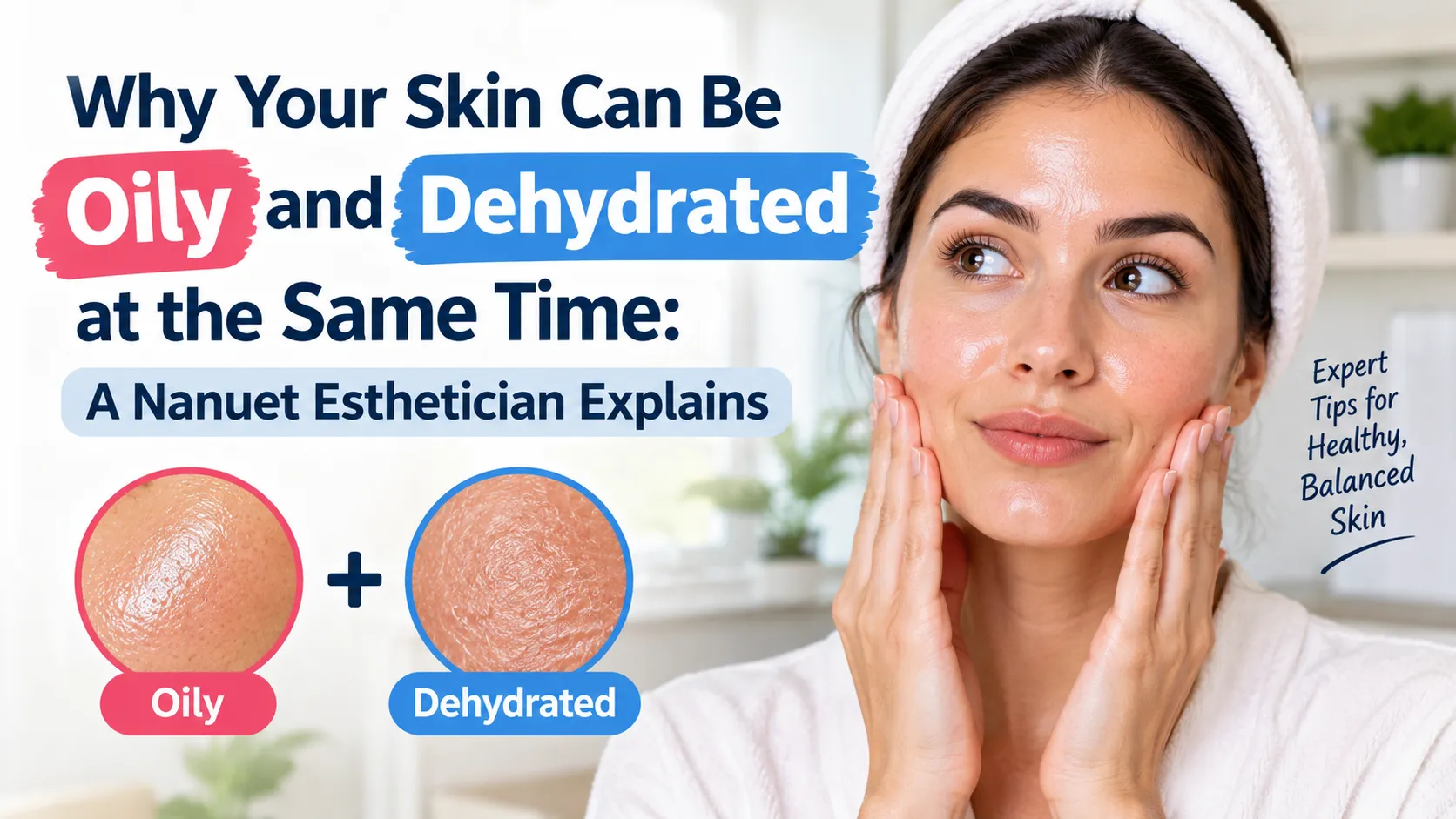
Your skin looks shiny by noon, but feels tight, dull, and parched. You’ve tried mattifying products. You’ve cut back on heavy creams. Nothing changes — because the problem isn’t your products. It’s your stress hormones. If you’ve been searching for the best Esthetician Nanuet NY to finally get a straight answer, here it is: oily, dehydrated skin is not a skincare failure. It is your body’s cortisol response playing out directly on your face, following a precise biological logic that most skincare content never reaches.
The Real Reason Your Skin Is Doing Both at Once
Most skincare advice treats oily-dehydrated skin as a mismatch between products and skin type. That framing misses the actual mechanism entirely.
Cortisol — your body’s primary stress hormone — is the driver. It does not cause one condition or the other. It triggers both simultaneously through two separate but linked pathways. Once you get a handle on those pathways, none of the cleanser switch outs or serum upgrades will really stick, not in the long run.
The worst misconception is basically that oily skin doesn’t need any moisture. Folks who show surface oiliness tend to skip hydration entirely, then they scrub ,and strip their complexion aggressively. Afterwards they end up confused, like why does the oiliness come right back even stronger. That bounce back is cortisol driven, and yeah it’s predictable once you actually understand the loop.
What Cortisol Is Actually Doing to Your Skin
Cortisol binds directly to receptors on the sebaceous glands. When cortisol levels rise — under chronic stress, poor sleep, or sustained pressure — sebum output increases. Dermatological research consistently links psychological stress to measurable spikes in sebum production. That explains the oiliness.
At the same time cortisol kind of suppresses ceramide synthesis. Ceramides are the lipids that kind of hold the skin barrier repair process together and help keep water locked inside the dermis. When cortisol degrades them, the barrier ends up more porous, and transepidermal water loss TEWL speeds up .
Both processes run in parallel. More oil on the surface. Less water underneath. This is one hormonal input producing two simultaneous outcomes — not two separate problems.
The standard framing — “stress causes breakouts” — wildly undersells what is happening. Breakouts are a surface symptom. What cortisol does to the barrier is structural and does not resolve without deliberate intervention.
Why the Skin Barrier Gets Caught in the Middle
The skin barrier is built from three components: ceramides, fatty acids, and cholesterol. Together, they form a seal that prevents water from escaping the dermis.
Cortisol attacks the ceramide layer specifically. Once compromised, the barrier cannot hold water regardless of what is applied on top. The result is skin that reads as oily to the touch but behaves as dehydrated underneath — tight after cleansing, prone to sensitivity, slow to recover.
This is not a skin type. It is a barrier integrity problem with a hormonal root cause.
The Signals You’re Probably Misreading
When skin looks oily, the instinct is to strip it. That instinct makes the condition worse in three specific ways:
-
Trying to use mattifying, or oil stripping products kind of helps right away, because it removes the surface sebum for a moment. But it also makes the barrier damage worse which cortisol already started. Then the sebaceous glands, respond by making more oil to kind of compensate, you know.
-
Skipping moisturizer entirely deepens dehydration and accelerates TEWL. The skin has no external support for a barrier it can no longer maintain internally.
-
Drinking more water supports systemic hydration but does not restore ceramides or stop cortisol-driven sebum overproduction. Necessary, but not sufficient.
DIY routines plateau here for a structural reason. They address symptoms — shine, tightness, texture — without touching the cortisol feedback loop producing them. Effective oily dehydrated skin treatment has to work at the barrier level, not just the surface.
What Actually Breaks the Cycle
The solution requires two things working in parallel: barrier repair and reducing the inputs that keep cortisol elevated. Neither is effective without the other.
At the ingredient level, the priority is replacing what cortisol degrades:
-
Ceramide-rich formulations directly replenish the lipids cortisol suppresses — the most targeted topical intervention available without a prescription.
-
Humectants applied correctly — on damp skin, sealed with a lightweight occlusive — prevent moisture from escaping a compromised barrier. Applied to dry skin in low-humidity conditions, humectants like hyaluronic acid pull water from the dermis rather than drawing it in. Sequence matters.
-
Surfactant-heavy cleansers should be avoided while the barrier is impaired. They strip residual lipids and extend the repair timeline.
On the cortisol side: sleep quality has the most direct impact on cortisol regulation. Chronic disruption to the natural cortisol rhythm sustains elevated levels, keeping both sebum and TEWL pathways active. Any oily dehydrated skin treatment plan that ignores barrier integrity works against the skin’s own recovery.
Where Professional Assessment Changes the Equation
Without measuring the barrier’s actual state, any routine is an educated guess. A trained esthetician can evaluate TEWL severity, identify overproducing sebum zones, and assess barrier integrity in ways self-diagnosis cannot.
That level of assessment is what the best Esthetician Nanuet NY at Rose Ela Skin Care provides. Skin barrier repair cannot be accurately staged without knowing where the barrier currently stands — a professional evaluation gives the routine a clinical foundation.
Get to the Root — Not Just the Surface
At Rose Ela Skin Care, 145 Main Street, Nanuet, NY, every treatment begins with a thorough skin analysis. The approach is clinical, individualized, and built around long-term correction — not temporary relief. If your skin has been stuck in this loop, the answer starts with understanding what your body is doing and getting qualified professional eyes on it. Book your appointment here.
Frequently Asked Questions
-
Can stress alone cause oily and dehydrated skin, even with a consistent skincare routine?
Yes. A solid routine cannot override a sustained cortisol response. Cortisol increases sebum production and degrades the ceramide layer simultaneously. No topical product corrects that upstream input. Stress management directly affects how the skin behaves, regardless of what you apply.
-
How long does the skin barrier take to recover once cortisol levels stabilize?
Barrier repair is not immediate. The skin’s ceramide synthesis cycle kind of takes around 28 days, assuming things are pretty favorable. But if cortisol stays elevated for longer, that schedule can stretch out, a lot. Usually most people need about 4 to 6 weeks of steady barrier focused care before there is a real, measurable uptick in hydration retention and sebum balance, it’s not instant you know.
-
Why does skin feel tighter and more dehydrated in the morning if cortisol peaks early?
Cortisol spikes quite sharply in the first 30 to 45 minutes after you wake up, that cortisol awakening response thing. For barrier-compromised skin, that morning “lift” actually speeds up transepidermal water loss overnight, an d that’s kind of the whole reason you end up with this tight, parched feeling before the day even really starts.
-
Is oily dehydrated skin a permanent skin type, or can it be corrected?
It is correctable. Oily dehydrated skin is a condition driven by an active hormonal and barrier integrity problem — not a fixed skin type. With the right mix of barrier repair stuff, cortisol regulation, and professional care, the skin kind of comes back into balance. The thing is, you really need to tackle the underlying root reason, not keep swapping symptom management for the long run indefinitely.